DUNSINK DEVELOPMENT: THE IMPACT ON CABRA
It’s important that in trying to solve one crisis that we don’t create another.
The Dunsink Urban Area Plan has the potential to deliver much-needed housing, but it must be properly planned and supported by essential infrastructure. With a population larger than Cabra moving into Dunsink, Cabra will face a large increase in traffic and further pressure on local infrastructure.
Dunsink will be nearly the same population size as Finglas and it’s important that it planned to help ease a housing crisis and not create another Ballymun.
Dunsink is located between Finglas, Ashtown, Castleknock and Blanchardstown. Although the Dunsink development covers 435 hectares, only 102 hectares are designated as net residential land — just under a quarter of the entire site. This excludes land reserved for schools, parks, commercial facilities and community uses. The net residential area is roughly equivalent to a square measuring one kilometre by one kilometre.
The Dunsink development intends to use the existing road network to accommodate the movements of 37,500 new residents. Ratoath Road already serves Finglas and Cabra and has limited capacity. The transport assessment further indicates that the Navan Road/River Road/Auburn Avenue junction is projected to approach operational capacity during peak periods following the full development of Dunsink. It also identifies existing delays at the M50 Junction 6 interchange, connecting the M50 and the Navan Road.
These are not simply local road concerns. They raise wider questions about whether the transport network can safely and efficiently accommodate a development of this scale.
Can public transport keep pace with development?
The plan places considerable emphasis on future public transport, including a potential Luas extension towards Tyrrelstown. However, the material supporting the plan identifies this as a long-term proposal, with planning and route alignment not yet commenced at the time of the Draft Plan. The Luas extension is not included in the current transport plan running to 2042 and it will not be considered until after 2042. Consequently, the development could progress substantially before this additional transport infrastructure becomes available, if it is delivered at all.
Schools & education
A new population on this scale will create substantial demand for school places, childcare and other educational services.
Although land has been allocated for schools within the Dunsink plan, allocating land does not guarantee that schools will be built when they are needed. The Department of Education is responsible for decisions regarding school provision and delivery, not Fingal County Council alone.
Until new schools are operational, families may have to seek places in surrounding communities, potentially increasing pressure on existing schools and adding to journeys made by parents and children.
GP services & community facilities
More residents will mean greater demand for GPs, healthcare, childcare, youth services, family supports, recreational facilities and other essential community services.
Existing services in Finglas, Cabra, Ashtown, Castleknock and surrounding areas cannot simply be assumed to have sufficient spare capacity to accommodate a substantial increase in population. Their ability to meet additional demand depends on available places, staffing, funding and facilities.
The phased delivery of Dunsink creates a particular challenge. New residents will need services from the moment they move into their homes, but the infrastructure and facilities intended to support the community may take longer to deliver.
Without coordinated planning and investment, the burden could fall on existing communities, which are already relying on local services to meet their own needs.
Cabra must not be overlooked
Dunsink is not a modest extension to an existing neighbourhood. It is a major new urban development with potential consequences for communities across north-west Dublin.
Cabra residents should not be expected to absorb the consequences of increased traffic and additional demand on local services without proper assessment, planning and investment.
The success of Dunsink should be measured not simply by the number of homes delivered, but by whether it becomes a sustainable community without undermining the quality of life of the people who already live nearby.
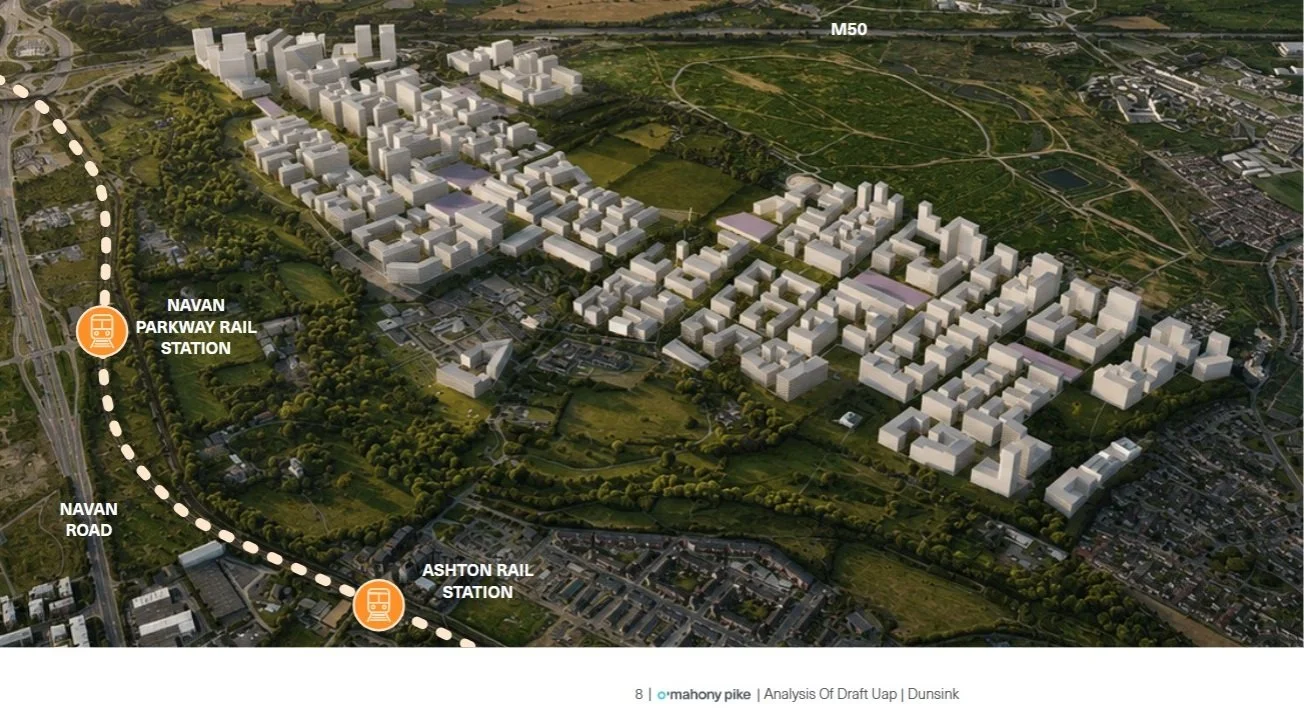
What does the proposed development look like?
Cabra and its neighbouring communities deserve to have their concerns taken seriously. The impact of Dunsink must be assessed across council boundaries, and the infrastructure needed to support this development must be planned, funded and delivered in step with housing.
The image below was generated by O'Mahony Pike Architects as part of the Dunsink Urban Area Plan consultation to give the public an indication of the proposed development's scale.