DUNSINK DEVELOPMENT: THE IMPACT ON FINGLAS
It’s important that in trying to solve one crisis that we don’t create another.
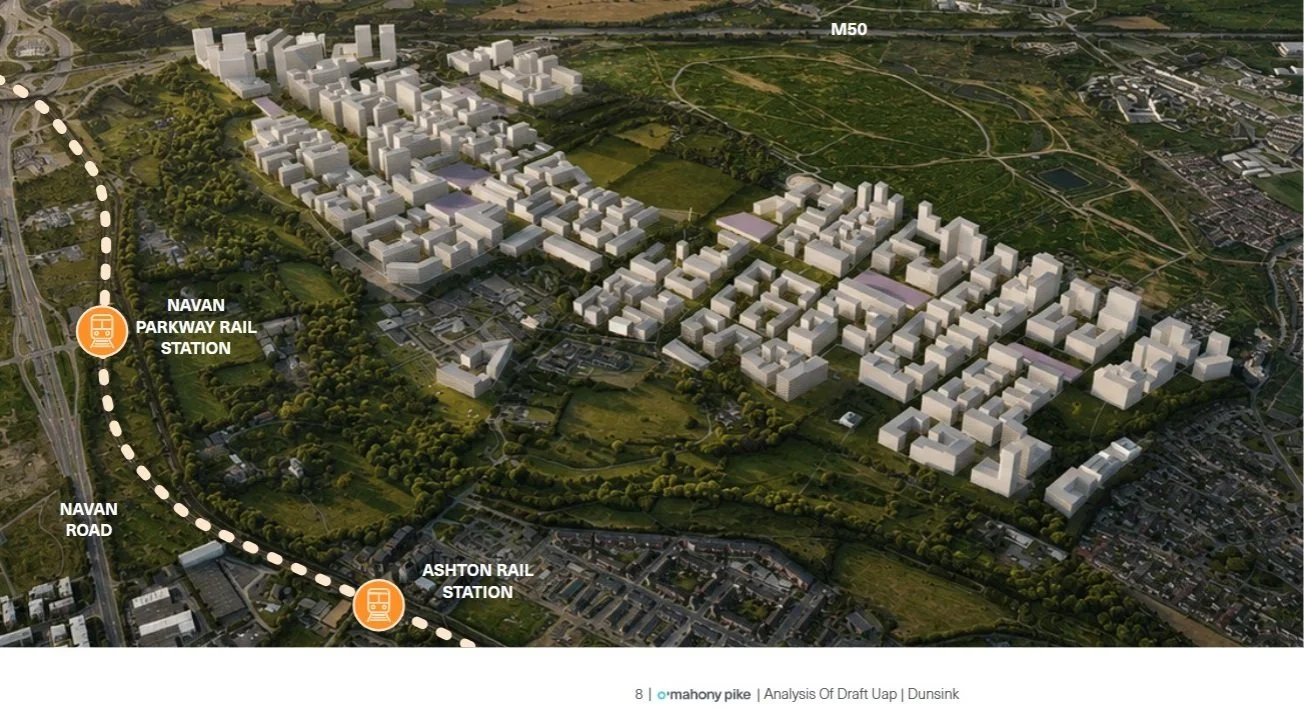
The proposed Dunsink Urban Area Plan will create a major new urban town beside Finglas. The Dunsink development has the potential to deliver much-needed housing, but it must be properly planned. Dunsink will create 15,000 high density ‘compact living’ units with a population of 37,500. The majority of the housing will be high rise apartments. In the 2022 census the population of Finglas was 42,638 and the new Dunsink development will have a population of 37,500.
Dunsink is located between Finglas, Ashtown, Castleknock and Blanchardstown. Although the Dunsink development covers 435 hectares, only 102 hectares are designated as net residential land — just under a quarter of the entire site. This excludes land reserved for schools, parks, commercial facilities and community uses. The net residential area is roughly equivalent to a square measuring one kilometre by one kilometre.
Dunsink will be nearly the same population size as Finglas and it’s important that it planned to help ease a housing crisis and not create another Ballymun.
Phases
The first two phases of the Dunsink development will be built on the Finglas side of Dunsink beside Dunsink Dump, Valley Park and Scribblestown. These will be 2,500 high density apartments (6,250 new residents) built in 2029. The development is starting beside Finglas (Dublin City Council) because Fingal County Council needs the existing road infrastructure of Dunsink Lane and Ratoath Road. It also needs access to Finglas schools, Garda, Fire, buses and doctor services until the development has been completed. This will put a lot of pressure on Finglas’ already depleted resources. To complete the full development Fingal County Council need the €7.3 billion Shannon to Dublin pipeline to build the full development, so there is a very real possibility that that Finglas and surrounding communities will be left with a half finished development until this is completed.
Densities
The current high density plan offers intense densities of 60-150 dwellings per hectare when the national recommendations is 40-80 dwellings per hectare. The proposed density is very high and it is similar to some of the busiest parts of Dublin Docklands and major European cities. Building so many homes in Dunsink without providing enough schools, healthcare, public transport, parks and community facilities will put further pressure on Finglas.
The proposed high-density development at Dunsink would see large apartment blocks overlooking Finglas, dramatically changing the surrounding landscape (see image at the bottom of the page). The current plan has large apartment blocks overlooking existing housing in Dunsoghly, Cappagh, Valley Park, Westwood and Scribblestown. Finglas residents should not have to bear the impact of excessive development without proper planning and investment.
We need to learn the lessons from previous developments and not recreate the mistakes of Ballymun.
Traffic and Road Safety
Dunsink will be relying on the existing road structures and it will place severe demands on surrounding roads, in particular, Ratoath Road, Tolka Valley Road, Cardiff Bridge, Cappagh, M50 and Ballyboggan Road.
Ratoath Road will be under considerable pressure as the traffic from Dunsink empties on to this road. Ratoath Road is a small two lane road which has limited capacity and has no space for a dedicated bus lane or an emergency services lane. With additional traffic from Dunsink feeding onto an already constrained road, congestion during peak hours would severely impede emergency services, compromising their ability to respond and current residents who want to use the road network.
Policing
Finglas Garda Station is identified in the Dunsink Urban Area Plan as part of the existing policing provision, despite community concerns that local Garda resources are already stretched. The Department of Justice has not allocated a Garda station to Dunsink yet and is Finglas expected to absorb additional demand while the new development is being built?
Schools, Healthcare and Public Services
Dunsink represents a major new urban settlement, not a modest neighbourhood extension. Thousands of additional residents will need schools, childcare, GPs, healthcare, Garda services and community facilities. The first phases are located beside Finglas and until the required schools are built they will be reliant on schools and services from the surrounding areas.
Existing services in Finglas cannot be assumed to have the capacity to accommodate significant population growth simply because they are nearby. Finglas has a strong community network, but schools, youth services, family supports, education, mental health, addiction and community services already face considerable pressure.
Finglas must not be expected to absorb the social and community costs of a major new development without additional investment.
Infrastructure Must Come First
The proposed Dunsink development raises serious questions about water infrastructure and the risk of housing delivery outpacing essential services. The Shannon-to-Dublin water supply project, a major infrastructure scheme estimated to cost €7.3billion has not yet commenced construction and remains subject to planning approval. If this waterpipe is not completed Finglas will be left with a half finished development of mostly high rise apartments.
Finglas and the surrounding communities must not be left dealing with the consequences of a half-finished development because essential infrastructure has failed to keep pace with housing delivery.
Transport Must Be Realistic
The Dunsink Plan places excessive reliance on the delivery of Luas Tyrrelstown after 2042 as the justification for very high apartment densities. The LUAS through Dunsink has not been approved and funding has not been allocated. The plan assumes a level of certainty around its delivery and timing that is not currently justified. A development of this scale should not depend on a transport project that has not yet entered the planning process. The plan must demonstrate how Dunsink can be adequately served by transport infrastructure that is deliverable, funded and operational in line with the phased delivery of housing.
Protect Tolka Valley Park, Scribblestown Lane and Local Biodiversity
Tolka Valley Park, Scribblestown Lane and surrounding green spaces are important assets for Finglas. They provide recreational opportunities, support wildlife and contribute to local quality of life. The Tolka Valley Park is the third most biodiverse park in Dublin and it needs to be protected.
Development and associated road infrastructure must not result in the unnecessary loss of mature trees, hedgerows, habitats or existing public green space.
A Permanent Green Buffer for Finglas
Fingal County Council should provide a substantial, permanent park buffer between the new Dunsink development and existing Finglas residential estates. Fingal County Council are proposing a whole new town of mostly high rise apartments that are going to be built on a very high hill and it is important to give some physical space between the small two storey houses and the large Dunsink apartment blocks.
This should be genuine, accessible public parkland — not narrow strips of landscaping or leftover space between buildings. A properly designed buffer could protect residential amenity, provide recreational space, support biodiversity and create a green transition between existing homes and the new development.
Community Facilities and Recreation
The new development must provide community facilities and recreational amenities that benefit both new and existing residents.
At the Dunsink UAP meeting on 19th of October 2026, Fingal County Council confirmed that the proposed playing pitches would be for Fingal clubs only. This raises questions about how recreational provision will serve neighbouring communities in Finglas.
We support housing. We support responsible development. We are calling for a plan that protects Finglas, provides the necessary infrastructure and works for both existing and future communities.