DUNSINK: WILL THE INFRASTRUCTURE BE READY?
It’s important that in trying to solve one crisis that we don’t create another.
The proposed Dunsink development represents a major expansion of Dublin, with the potential to create a new urban community of 37,500 new residents. But delivering homes is only one part of the challenge. Will the infrastructure be ready in time?
Without the necessary infrastructure, Dunsink risks becoming a partially completed development where housing arrives before the services residents need—and where existing communities in Finglas, Cabra, Ashtown, Castleknock and surrounding areas are left to absorb additional pressure.
The central question is straightforward: is the infrastructure funded, approved and scheduled to be delivered in time to support the proposed scale of development?
The €7.3 Billion Shannon-to-Dublin Pipeline
The proposed Shannon-to-Dublin water supply pipeline, estimated at €7.3 billion, raises an important question about the long-term water infrastructure needed to support Dublin's growth. If the pipeline is not built in time for the phasing of the development Dunsink will be left with a half finished development and will not be completed until this national pipeline is built.
Public Transport: Do Not Build on Unconfirmed Promises
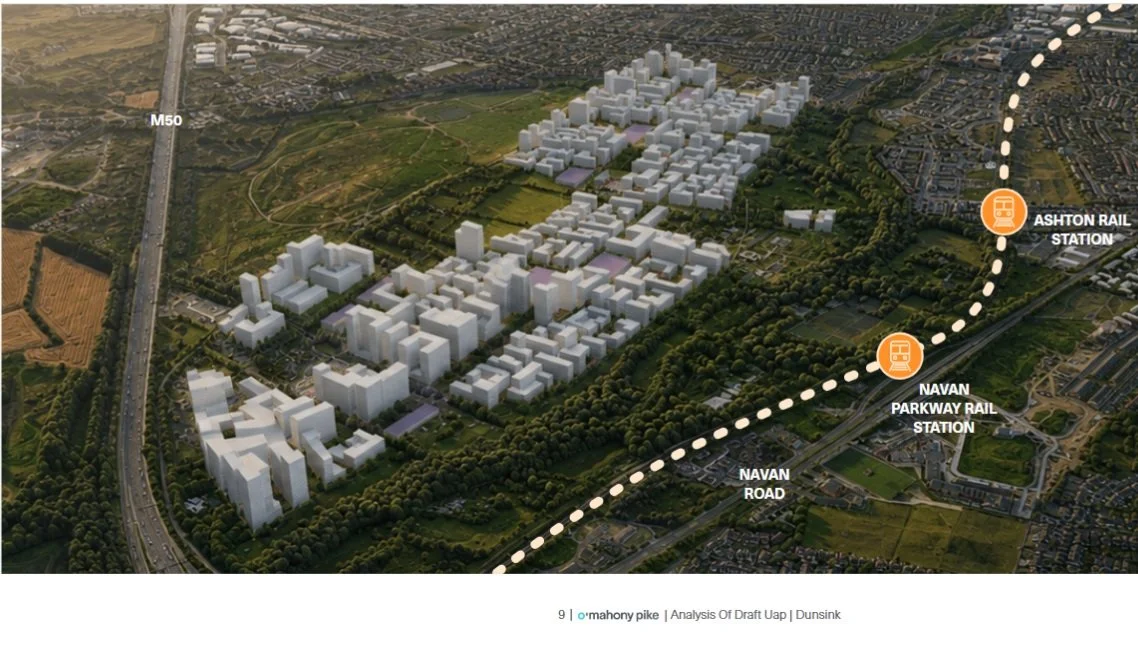
The Draft Plan relies on a combination of existing rail services, future transport improvements and proposed bus-route changes.
The Department of Transport recommended that further modelling be undertaken without these proposed modifications to avoid overly optimistic results. This matters because transport modelling influences judgements about whether the surrounding road network and public transport services can accommodate the development.
A future Luas extension after 2042 (it is not currently funded or the route confirmed) cannot substitute for reliable public transport during the years before it is delivered.
Roads and Junctions: Existing Communities Must Not Carry the Burden
The new development will place pressure on local roads and junctions serving Dunsink and neighbouring communities. Fingal County Council intends to use the current road network to service Dunsink. The impacts will not stop at the boundary of the development or at the boundary between local authorities.
Finglas, Cabra, Ashtown, Castleknock and surrounding neighbourhoods will be affected by the traffic generated by 37,500 new residents.
The Dunsink Plan itself acknowledges that parts of the surrounding road network are already approaching capacity. Adding thousands of homes will place further pressure on roads such as Ratoath Road, Cappagh, Ashtown Road, Auburn Avenue, River Road, Junction 6 M50 and Navan Road.
Schools, Healthcare and Community Services
A new community of this scale will need substantial social infrastructure. The Dublin Northwest Partnership submission highlighted the importance of delivering childcare, primary and post-primary education, youth services, family support, healthcare, mental health services, disability supports, sports facilities and community resources alongside housing. It also warned that the presence of services in surrounding areas does not prove that they have spare capacity to accommodate a major increase in population.
Reserving land for a school is not the same as opening a school. Identifying a location for a community centre does not guarantee that it will be built, staffed and funded.
Dunsink must not be allowed to become a half-finished development: thousands of homes occupied while essential infrastructure remains delayed, uncertain or unfunded.
The people who will live in Dunsink deserve more than a promise that infrastructure will follow. Existing communities deserve protection from the consequences of infrastructure arriving too late.